
Mt Everest, (Pvt.) Ltd.
Nepali Times ईspecial 22 -28 May 2026 #1312

Dear Social Climbers,
Let’s face it. The only reason Mt Everest happens to be half-situated in Nepal is so that we can make money off it, right? Otherwise, what’s the point?
There will be whiners who complain about leaving the mountains alone, and saving the wilderness. But in the bigger scheme of things, we have to ask ourselves: is the rock proving its worth? Is it earning its keep? If not, as George Mallory may have said, why is it there?
It is a shame that on social media people are livid at the crowds lining up at the Hillary Step this week and lashing out at the crass commercialisation of Our Sagarmatha. My take is that we have not even scratched the tip of the iceberg to make mountains of money out of this mountain.
That is why I have come up with some unsolicited tips for the Ministry of Civil Aviation, Neoliberalism and Tourism (MoCANT) on how to tap the full potential of Mt Neverest becoming a money spinner. In my humble opinion, these suggestions would help the Finance Minister achieve his ambitious goal of reaching $3,000 per capita GDP and a $100 trillion economy well ahead of schedule.
Here are my bright ideas:
To make a real killing, we have to Think Big. We can start by adding elevation to Mt Everest. If it is higher, we can charge higher fees. Every expedition must henceforth carry its trash to the summit for disposal instead of bringing it down to Base Camp. In my back of the envelope calculation, using the peak as a landfill site would increase the mountain’s height to 9,000m within the next fiscal year.
Why stop at garbage? MoCANT can mandate that every expedition carry rocks from the Yellow Band and deposit them on the peak. Foreigner climbers will be required to carry 15kg of rocks, while Nepali nationals will only carry 10kg. Each climber will be awarded a certificate at the end of the climbing season as a token of appreciation. This would rake in $10 million in additional royalty fees annually.
Since there are now view towers on every hilltop, why not build one on the world’s highest peak? It can have a revolutionary restaurant on top (a Hard Rock Cafe franchise?) that can be reached by cable car up the Khumbu Glacier, funicular along the Lhotse Face and then an escalator from the South Col to the summit. Ticket costs can be added to the permit fees, with a surcharge for foreign mountaineers.
Now that an Airbus AS350 B3 has proven that a helicopter can land on the summit of Mt Everest without Nepal government permission, chopper companies can charge an arm and a leg to illegally get mountaineers directly to the top without actually having to take the unnecessary trouble of climbing.
All this as preamble to our roundup of Himalayan climbing in this edition of Nepali Times. One way to reduce crowds on Mt Everest, as Vishad Raj Onta argues on page 9 (Rush Hour Traffic at 8,848m) is to remove the cutoff date of 31 May for the spring season. This is a serious suggestion. That rule was made in the old days because expeditions had to march for up to a month to get to Base Camp and there were no roads. Now, with better connectivity and unpredictable onset of monsoons due to climate change, climbing seasons need not be so strictly demarcated. That would also spread out the expeditions, and reduce overcrowding.

One cannot ignore politics these days, and on page 1 Editor Sonia Awale looks at how the RSP is grappling with a transformative budget at a time of economic crisis due to the West Asia war, Nepal deferring LDC graduation, and the rumoured friction between the PMO and the Finance Ministry (Rebuilding New Nepal).
Still on the subject of Nepal’s graduation to middle income status, feminist economist Bina Pradhan proposes that future strategy account for the under-recognised contribution of the care economy and emphasise green growth to lure Nepalis back. Nepal has already graduated from LDC status, and a deferral would distract from much-needed structural reforms (Rethinking Nepal’s Graduation to Middle Income, page 4).
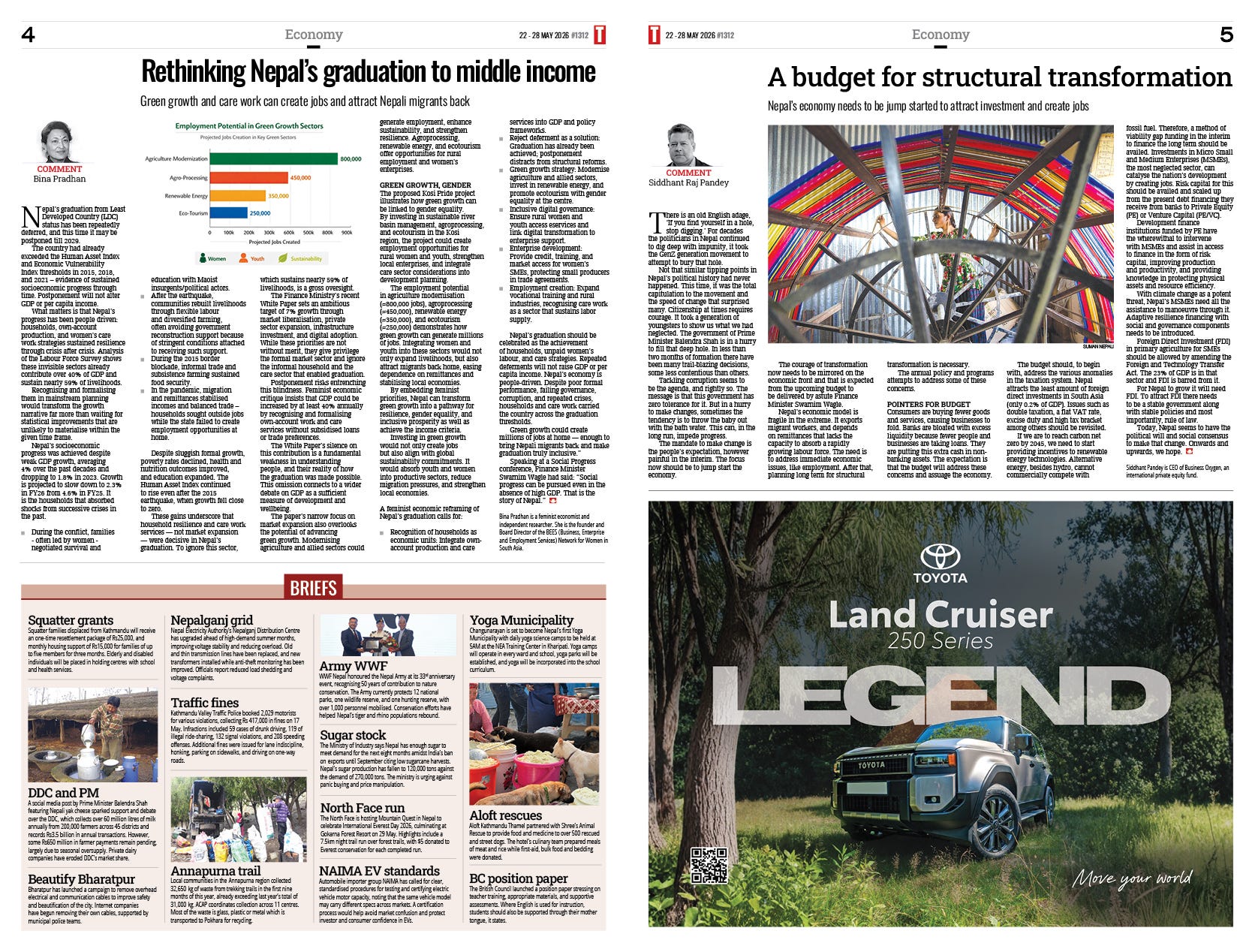
Investment banker Siddhant Pandey has some pointers for the Finance Minister to jump start the economy to attract FDI and create jobs, as he prepares to present the budget to Parliament this week (A Budget for Structural Transformation, page 5).
On page 2, I pitch in with an Editorial that looks at the polarisation in Nepali society and politics between supporters of Prime Minister Balendra Shah and his critics. It looks like a cross between a debating society and a bar room brawl. There are those in favour of the motion that the PM is doing a good job, and those against. My conclusion is that the debate is getting incendiary, and needs to be resolved rapidly for the country’s sake (Nepal’s National Debate Championship).

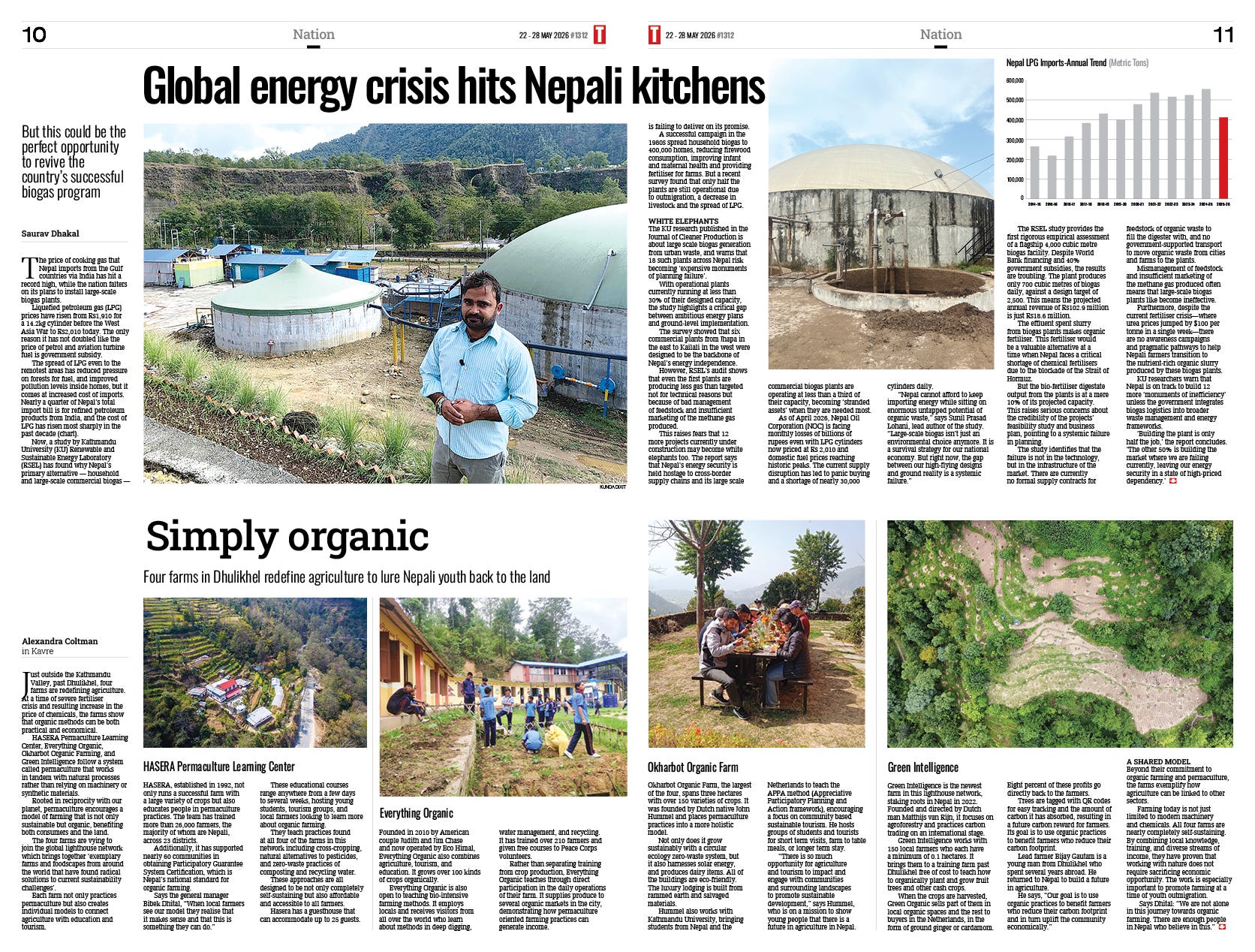
With no end in sight to the lifting of the Hormuz blockade the fuel crisis is biting. Nepal may have to fall back on its once successful household gobar gas campaign, and revive the faltering projects to use urban waste to generate utility scale biogas to reduce Nepal’s dependence on LPG imports. Saurav Dhakal has an assessment on pages 10-11 (Global Energy Crisis Hits Nepali Kitchens).
This is accompanied by a report on permaculture to revive agriculture with four model farms in Kavrepalanchok district. Alex Coltman’s field report is on pages 10-11 (Simply Organic).
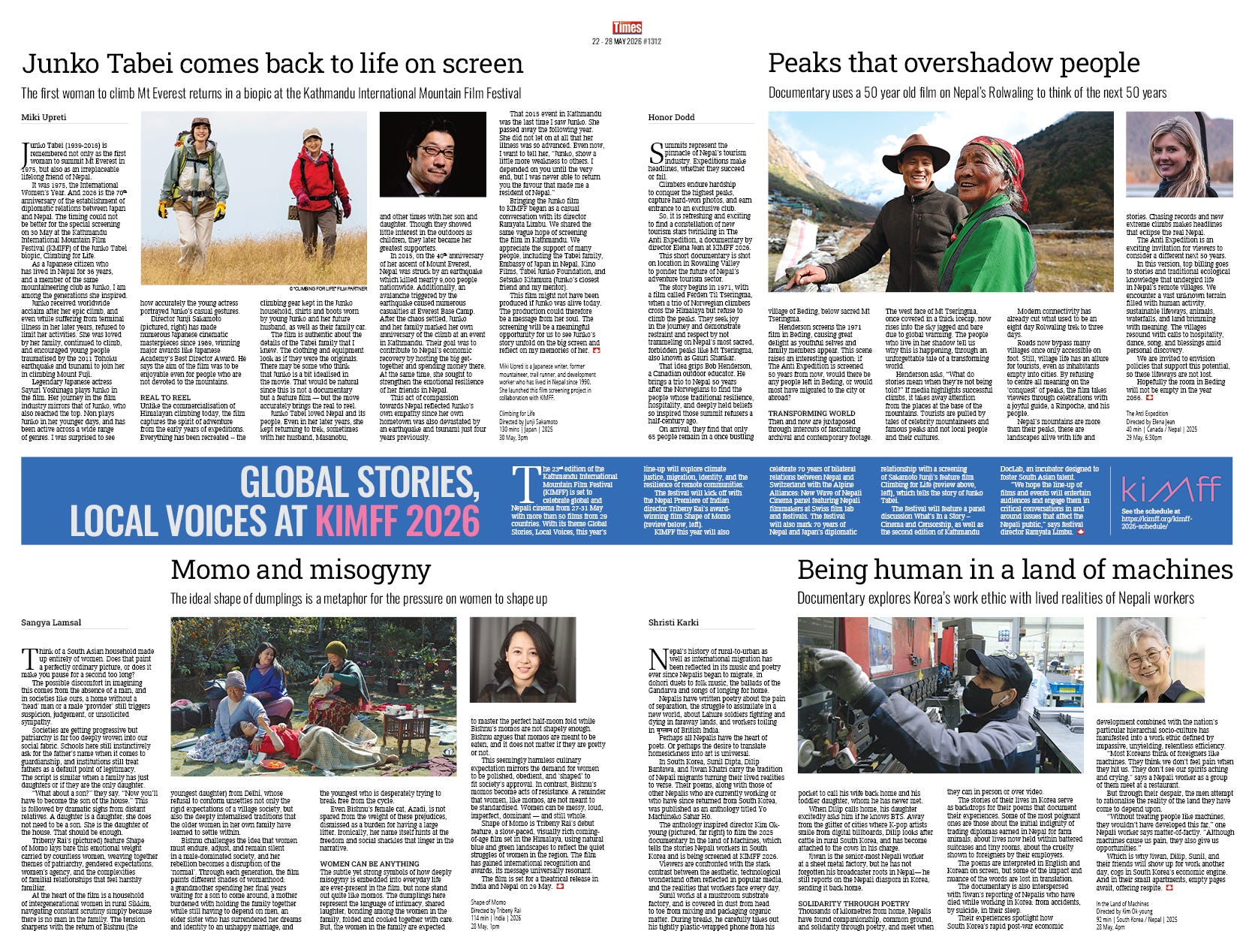
This week is the Kathmandu International Film Festival (KMIFF), and on page 6-7 we carry reviews of some of the highlights:
* Miki Upreti reviews a biopic of Junko Tabei on the 50th anniversary of her being the first woman to summit Mt Everest (Junko Tabei Comes Back To Life on Screen).
* Sikkimese director Tribeny Rai’s award-winning film Shape of Momo is reviewed by Sangya Lamsal.
* The Anti Expedition is a critique by Elena Jean of industrial-scale mountaineering from the viewpoint of Rolwaling’s Sherpa community (Peaks that Overshadow People).
* Shristi Karki reviews In the Land of Machines by Kim Ok-Young about Nepali workers in Korea.
Enjoy the week of powerful documentaries in Kathmandu.
Kunda Dixit
Why so salty?
Nice coverage of rush hour traffic,the fate of the Everest being so crowded, what a mass climbing, sad for the nature , for the mountain environment.