
PM, DM, OM
Nepali Times ईspecial 19 - 25 June 2026 #1316
If it is this difficult for us hacks to figure out which ministers have which portfolio these days, imagine what it is like for ordinary non-hacks. So, I have asked Claude for help in drafting this explainer to navigate the cabinet and the skeletons therein.
During the ancien régime, coalitions needed up to 30 ministries to fit everyone in nice and cosy. But now, thanks to the Balen Sarkar’s commitment to make government machinery more aerodynamic, many erstwhile ministries have been merged.
For example, we now have a Ministry of Women, Children, Gender and Sexual Minorities and Social Security, and this hefty workload falls on the slender shoulders of the Hon’ble Sita Badi. Then there is Ministry of Energy, Water Resources and Irritation where Hon’ble Biraj Bhakta Shrestha has been twisting some tails.
I have an idea. In the interest of even more thrift and frugality, how about merging some of the other ministries that do not have much to do? Luckily for us, the PM has himself shown the way by posting a picture of PM, HM, and IM as the only three ministers needed to fix the country. Smart move that he is keeping some important portfolios for himself, for example besides being Prime Minister (PM) he is also Defence Minister (DM) and Offence Minister (OM).
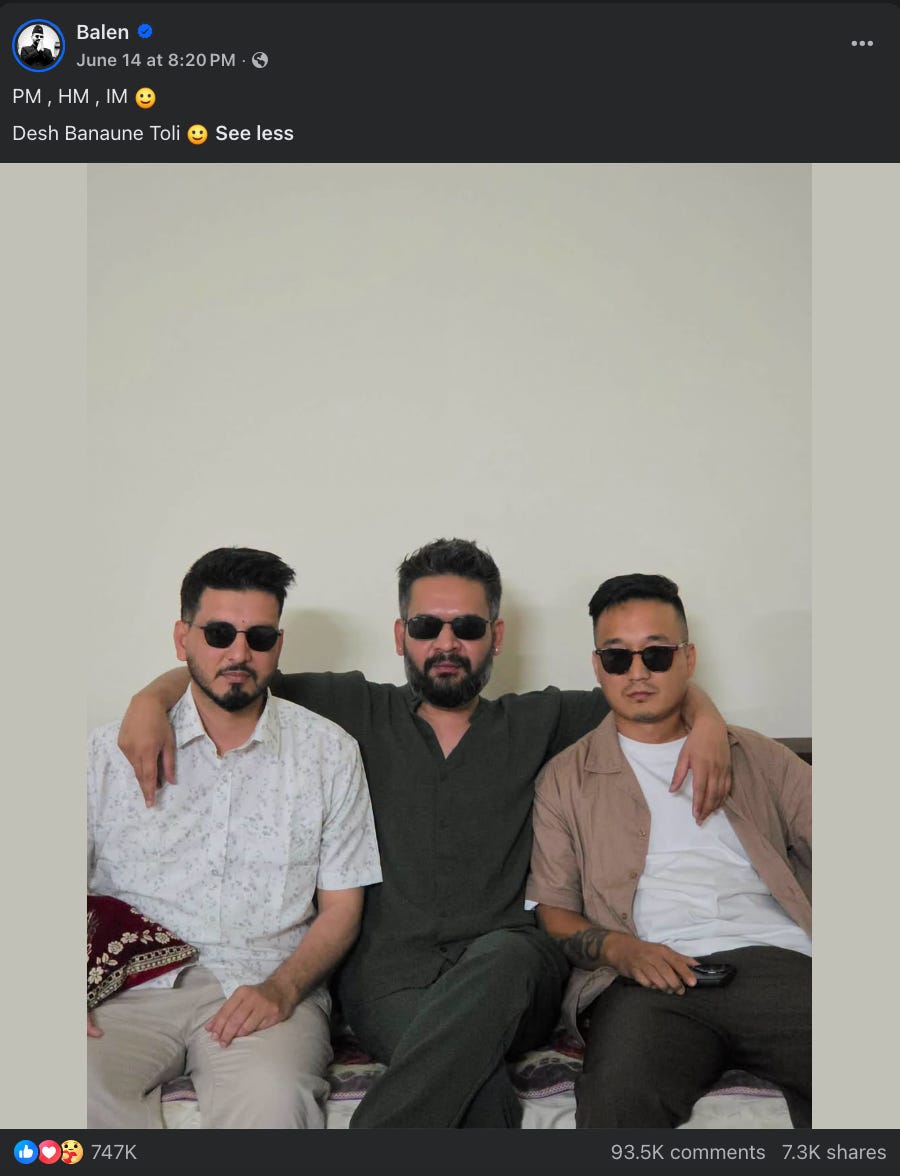
He could also combine several other related ministries and save tons of money that can then be spent on urgent projects like installing stadium floodlights on every alleyway. For example, how about creating a super-jumbo Ministry of Science, Technology, Innovation, Education, Uncivil Aviation, Tourism, Totalitarianism, Disinformation and Miscommunication? And since one minister cannot conceivably look after all those sectors, there is less chance of him/her/it committing major mistakes.
There are other portfolios in the Council of Ministers ripe for unification, like bringing everyone under the Ministry of Culture, Agriculture and Vermiculture, Industriousness, Commercialism and Lack of Supplies.
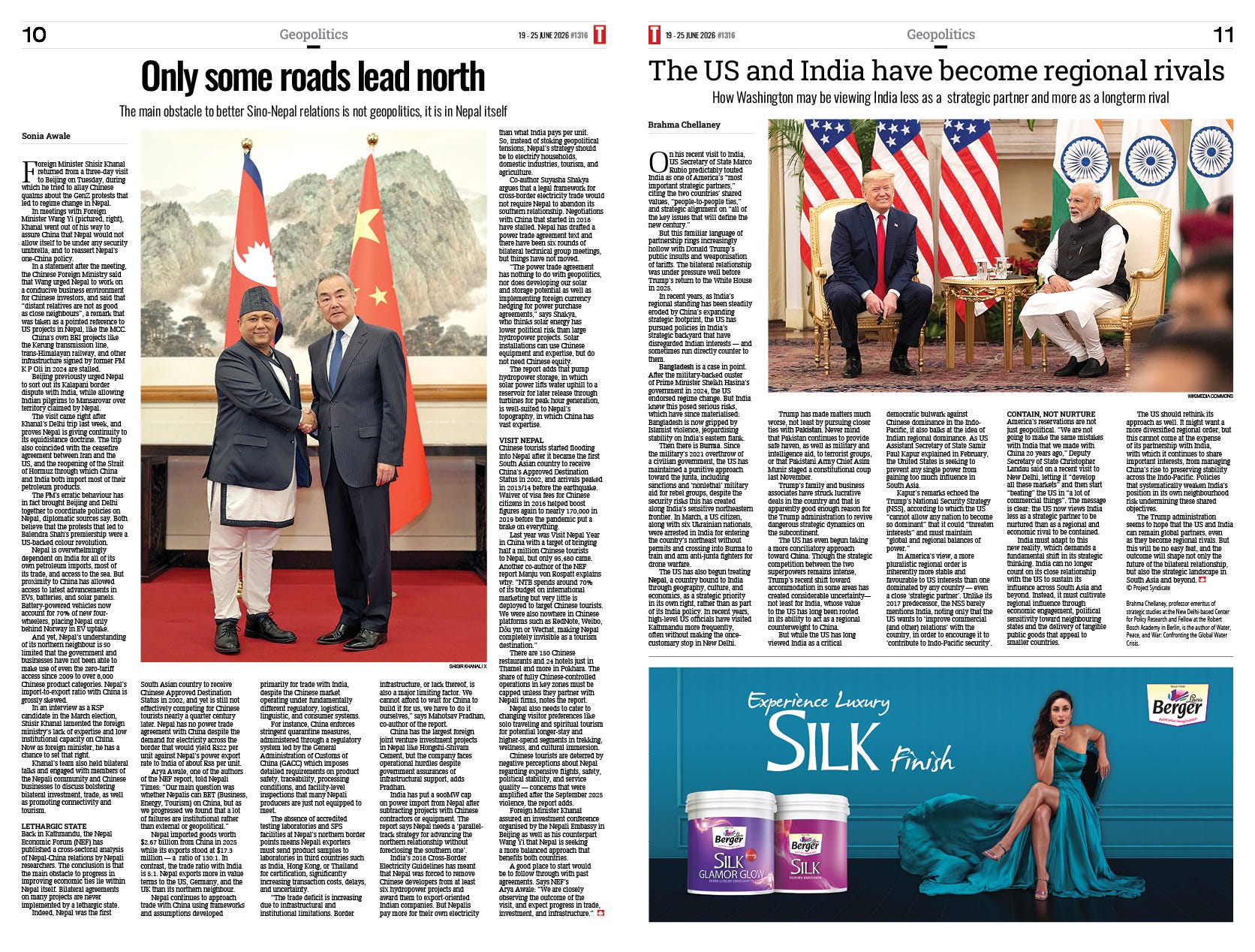
Foreign Minister Shisir Khanal does not have that problem, since he only handles one portfolio. He has just returned from his high wire balancing act by making back-to-back visits to New Delhi and Beijing. Sonia Awale analyses the ripples from the China visit and quotes a soon to be released Nepal Economic Forum report that says the main obstacle to closer Sino-Nepal साइनो is not geopolitics, but Nepal’s own lethargic state. (Only some roads Lead North, page 10).
Yes, I know. This heat is driving us crazy. If it is this hot here in pre-monsoon Kathmandu, imagine what it must be like in the Tarai. Glad to see that there is a sense of urgency across the border about tackling the El Niño phenomenon because some believe it is a nefarious plan to spread Christianity.
And it is going to get much hotter both in the thermal sense as well as the figurative sense. Pokhara and Muktinath are chock-a-block full of Indian tourists fleeing the searing heat of the plains where it has been 45°C for weeks on end. It looks like the Nepal Tourism Board’s slogan from 10 years ago, गर्मी से बेहाल, चलो नेपाल was way ahead of its time. Durga Rana Magar talks to some Indian visitors in Pokhara in her page 1 report, Visit Nepal, It’s Cool.

Sustainable tourism expert Shailendra Thakali writes a Guest Comment on the same theme from Ilam and Jomsom, warning that the surge of Indian visitors this summer has put a strain on Nepal’s infrastructure, and highlights issues of equity and preparedness. The lesson is that we have to be prepared for the mass migrations of the future as millions of people in the Subcontinent seek cooler climes. (Indian Off-season Tourism Boom in Nepal, page 2).
Development economist Suugam Nanda Bajracharya has just returned from the Philippines and writes about the extreme income inequality he saw there. He says remittance-driven Nepal should similarly try not to make the same mistakes as the Philippines (Nepali and Philippine Economic Models, page 4-5).

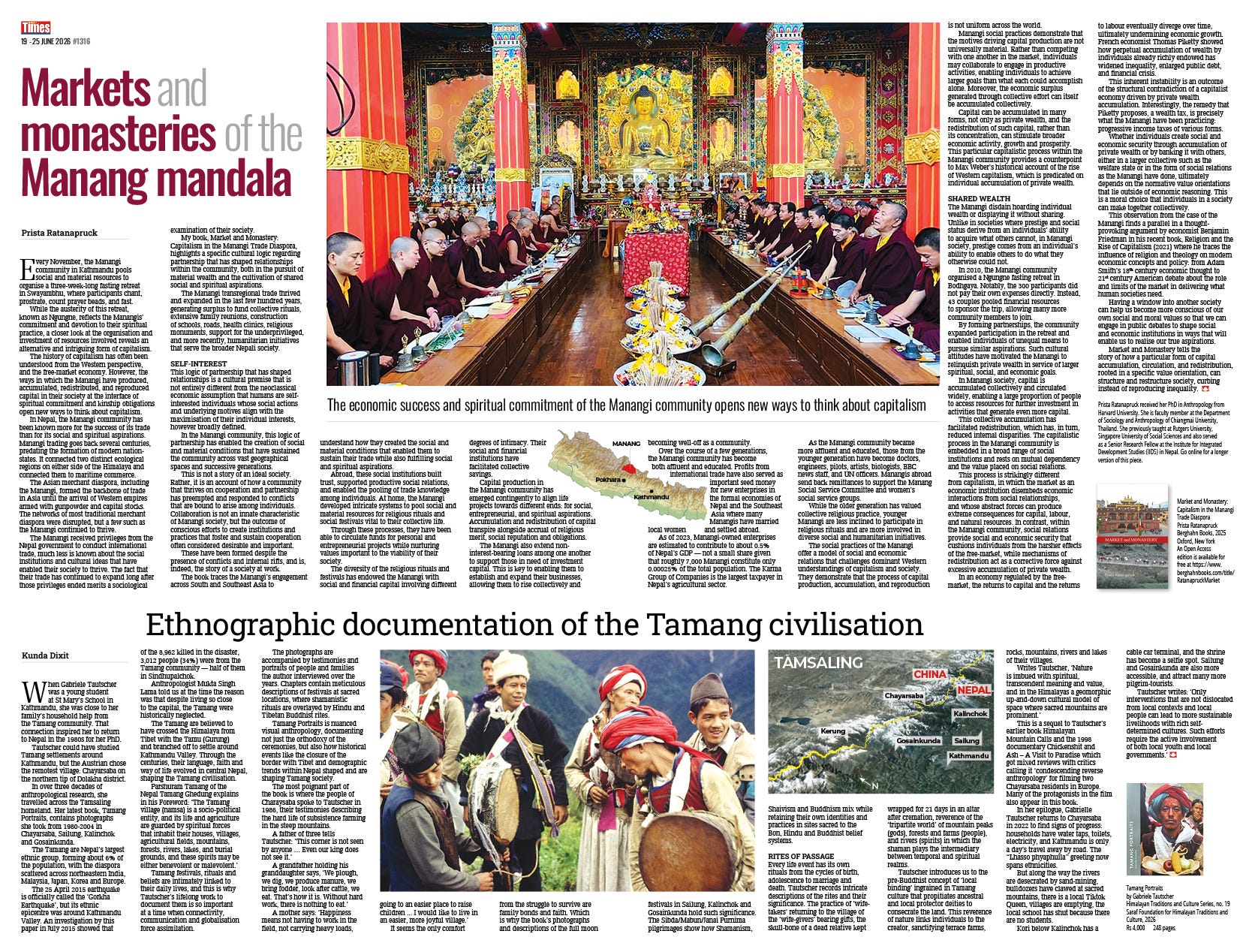
The centerfold in this week’s issue is devoted to two recent books. Thai anthropologist Prista Ratanapruck summarises her research into Nepal’s Manangi traders to find a new model of religio-capitalism that is as much about wealth accumulation as it is about accumulating spiritual merit (Markets and Monasteries of the Manang Mandala, page 6-7).
And I review Austrian researcher Gabriele Tautscher’s book on the Tamang people containing 40-year-old testimonies and photographs of their Tamsaling homeland (Ethnographic Documentation of the Tamang Civilisation, pages 6-7).
For those of you reading this in Nepal, you will have to cope with the heat for a few more days. The monsoon should set in by early next week to turn our dusty roads into muddy ones.
Kunda Dixit